- Do you need help? Here Us:
- +86 13169905499
- sunny@handaspring.com
- Wechat:13169905499

 English
  中文 (中国)
Chenzhou, Hunan, China(423000)
- 2026年1月24日
- handasprings
- Read: 333
Loss of force in canted coil springs can lead to poor electrical contact and sealing failure. Learn the root causes, failure modes, and proven engineering solutions to ensure long-term spring performance.
Loss of Force in Canted Coil Springs: Causes, Failure Modes, and Solutions
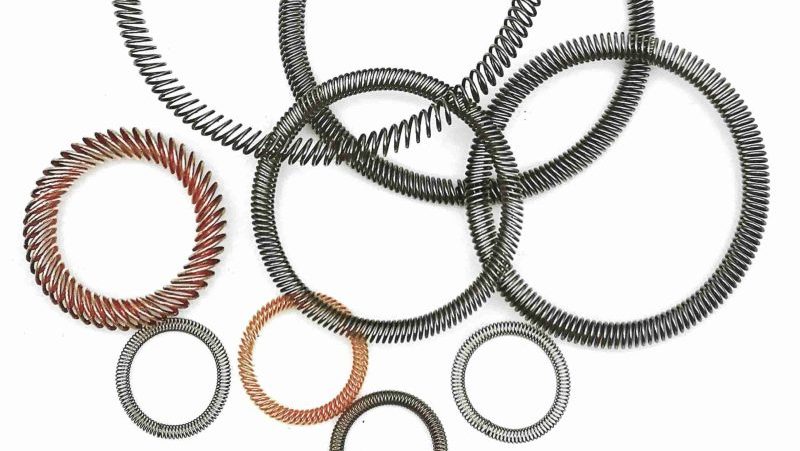
Canted coil springs are widely used in electrical contacts, EMI shielding, sealing systems, and precision mechanical assemblies due to their ability to deliver near-constant force over a wide deflection range. However, in demanding environments, engineers may encounter a critical issue: loss of force over time.
When a canted coil spring loses force, it can result in intermittent electrical contact, reduced shielding effectiveness, leakage, or complete system failure. Understanding why force loss occurs—and how to prevent it—is essential for ensuring long-term reliability.
This article explores the primary causes, typical failure modes, diagnostic methods, and proven solutions for loss of force in canted coil springs.

What Does “Loss of Force” Mean in Canted Coil Springs?
Loss of force refers to a reduction in the spring’s ability to maintain its designed load or contact pressure under a given deflection. Unlike conventional compression springs, canted coil springs rely on angled coils and elastic deformation to generate consistent force.
When force loss occurs, the spring may:
-
Fail to maintain electrical continuity
-
Provide insufficient EMI/RFI shielding pressure
-
Lose sealing integrity under vibration or thermal cycling
Primary Causes of Force Loss in Canted Coil Springs
1. Material Stress Relaxation
Stress relaxation is one of the most common causes of force loss, especially at elevated temperatures.
-
Occurs when the material gradually loses internal stress under constant deflection
-
Accelerated by high temperature and long dwell times
-
Common in stainless steel springs used beyond their thermal limits
High-risk environments: aerospace, automotive under-hood, power electronics
2. Plastic Deformation (Over-Compression)
If a canted coil spring is compressed beyond its elastic range, permanent deformation may occur.
Typical causes include:
-
Incorrect groove depth or width
-
Excessive assembly force
-
Tolerance stack-up issues
Once plastic deformation occurs, the spring cannot recover its original force level.
3. Material Fatigue from Cyclic Loading
Repeated compression and release can lead to fatigue-induced force degradation.
Factors that accelerate fatigue:
-
High cycle counts
-
Large deflection amplitudes
-
Sharp groove edges causing stress concentration
4. Inappropriate Material Selection
Not all spring materials perform equally under extreme conditions.
| Material | Temperature Resistance | Stress Relaxation Resistance |
|---|---|---|
| Stainless Steel | Moderate | Moderate |
| Beryllium Copper | Good | Good |
| Elgiloy® | Excellent | Excellent |
| Inconel® | Outstanding | Outstanding |
Using the wrong material can dramatically shorten service life.
5. Environmental Degradation
Corrosion, oxidation, and chemical exposure can reduce effective cross-section and elasticity.
Common contributors:
-
Humidity and salt spray
-
Industrial chemicals
-
Galvanic corrosion in mixed-metal assemblies
Common Failure Modes Resulting from Force Loss
| Failure Mode | System Impact |
|---|---|
| Intermittent electrical contact | Signal loss, system instability |
| Reduced EMI shielding | Compliance failures |
| Seal leakage | Contamination or pressure loss |
| Increased contact resistance | Heat generation and wear |
These failures often appear gradually, making early diagnosis critical.
How to Diagnose Loss of Force Issues
Engineers can identify force loss through several methods:
-
Load-deflection testing to compare initial and aged performance
-
Thermal aging tests to evaluate stress relaxation
-
Visual inspection for coil distortion or flattening
-
Electrical resistance monitoring in contact applications
Early detection helps avoid costly field failures.
Engineering Solutions to Prevent Force Loss
1. Optimize Material Selection
Select materials based on temperature, load, and environment, not just cost.
-
Use Elgiloy® or Inconel® for high-temperature or long-life applications
-
Choose Beryllium Copper for electrical contact stability
2. Improve Groove Design
Proper groove geometry is essential.
Key design rules:
-
Avoid over-compression beyond recommended deflection
-
Ensure smooth groove surfaces
-
Maintain consistent radial clearance
3. Control Deflection Range
Operating the spring within its optimal deflection window minimizes fatigue and stress relaxation.
4. Apply Surface Treatments or Plating
Plating such as gold, silver, or tin-nickel can:
-
Reduce corrosion
-
Improve electrical performance
-
Extend operational life
5. Work with an Experienced Manufacturer
Custom-engineered canted coil springs offer:
-
Tailored material and geometry
-
Application-specific testing
-
Predictable long-term performance
When to Consider Custom Canted Coil Springs
Standard springs may not be sufficient if your application involves:
-
Extreme temperatures
-
High vibration
-
Tight tolerance assemblies
-
Long service life requirements
Custom solutions help eliminate force loss before it becomes a failure.
Conclusion
Loss of force in canted coil springs is not a random failure—it is usually the result of material limits, design oversights, or environmental stress. By understanding the causes and failure modes, engineers can implement targeted solutions that ensure consistent force, reliable contact, and extended service life.
With the right material, proper groove design, and expert manufacturing support, canted coil springs can maintain their performance even in the most demanding applications.