- Do you need help? Here Us:
- +86 13169905499
- sunny@handaspring.com
- Wechat:13169905499

 English
  中文 (中国)
Chenzhou, Hunan, China(423000)
- 2026年3月4日
- handasprings
- Read: 487
Discover how compression range impacts canted coil spring performance in sealing, electrical contact, and EMI shielding applications. Learn about near-constant force characteristics, design optimization, and selection guidelines for your engineering projects.
In precision engineering applications—from semiconductor equipment to aerospace sealing systems—the performance of a canted coil spring is fundamentally determined by how it behaves under compression. Unlike conventional springs that follow predictable linear force increases, canted coil springs offer unique mechanical characteristics that make them ideal for demanding applications where consistent force is paramount.
But what exactly happens when you compress a canted coil spring? How does the compression range affect its ability to seal, conduct electricity, or provide mechanical retention? This comprehensive guide explores the relationship between compression range and spring performance, providing engineers with the knowledge needed to optimize their designs.
1. Understanding Canted Coil Spring Geometry

1.1 What Makes Canted Coil Springs Different?
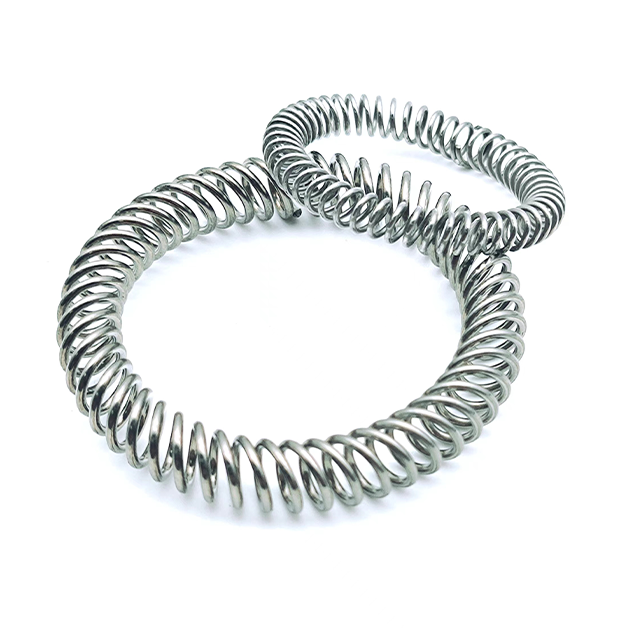
A canted coil spring—also known as a slanted coil or slant wire spring—features coils wound at a precise angle (typically 15° to 45°) relative to the spring’s central axis . This “canted” orientation is the key to its distinctive performance characteristics.
Key structural features include :
-
Coil orientation: Tilted rather than perpendicular to the spring axis
-
Independent coil action: Each coil can deflect individually
-
Multi-directional compliance: Accommodates both radial and axial movement
-
Distributed contact: Multiple points of contact along the spring length
1.2 The Compression Mechanism
When a canted coil spring is compressed, the angled coils undergo a rolling deflection rather than simple axial stacking . This rolling action creates a force-deflection curve that is remarkably flat compared to traditional spring designs .
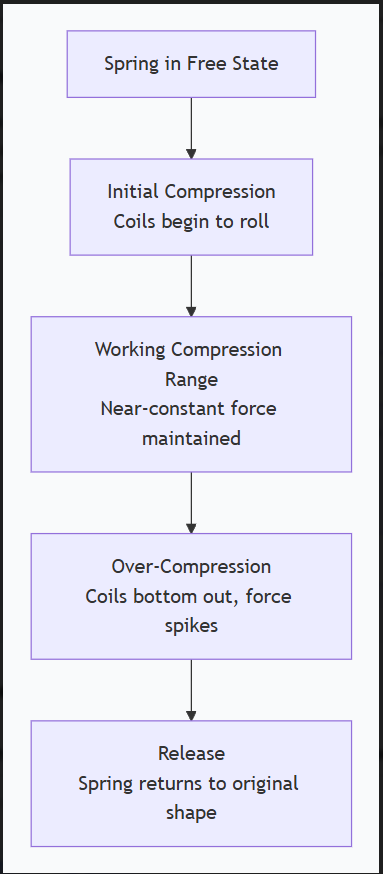
The most significant advantage of canted coil springs is their ability to maintain near-constant force across a wide compression range . This behavior fundamentally differs from conventional springs:
2.2 Why Constant Force Matters
In applications involving electrical conduction or EMI shielding, performance is governed not by maximum load capacity, but by how consistently force is maintained across displacement . Unstable contact force can result in:
-
Increasing contact resistance
-
Signal noise or intermittent conduction
-
Fretting corrosion caused by micro-motion
2.3 The Force-Deflection Curve
The unique geometry of a canted coil spring enables what engineers call a “flat” or “horizontal” force-deflection curve over the usable life of the spring . This means that as deflection increases within the working range, the force remains remarkably stable.
![Conceptual force-deflection curve showing flat response of canted coil spring compared to linear response of helical spring]
*Figure 1: Comparative force-deflection behavior of canted coil vs. helical springs (conceptual illustration)*
3. Compression Range and Performance Parameters
3.1 Optimal Compression Range
Research indicates that canted coil springs maintain optimal performance within a specific compression range. For most applications, the recommended compression is approximately 25% of the spring’s free height . Operating within this range ensures:
-
Maximum fatigue life
-
Consistent force output
-
Minimal permanent set
-
Optimal electrical contact resistance
3.2 Effects of Under-Compression
When a canted coil spring is compressed less than the recommended minimum:
-
Insufficient contact force: May lead to intermittent electrical connection or sealing leakage
-
Vibration sensitivity: Spring may not maintain consistent contact under dynamic conditions
-
Reduced EMI shielding effectiveness: Gaps in conductive path can compromise shielding performance
3.3 Effects of Over-Compression
Compressing a canted coil spring beyond its recommended range can cause:
-
Force spike: The flat force curve ends as coils begin to bottom out
-
Permanent deformation: Exceeding elastic limits may cause compression set
-
Reduced fatigue life: Higher stresses accelerate wear and failure
-
Potential damage: Extreme over-compression can permanently deform the spring
3.4 Temperature Effects on Compression Performance
Temperature significantly affects canted coil spring behavior. Studies on super-alloy canted coil springs show that :
-
Room temperature: Excellent compression-rebound performance, with springs maintaining specified force within the working range
-
High temperature (950°C): Compression-rebound performance decreases noticeably, though still meets requirements for many applications
Temperature affects spring force primarily by influencing the elastic modulus of the spring material .
4. Design Optimization for Compression Range
4.1 Key Design Variables
Engineers can optimize canted coil spring performance for specific compression requirements by adjusting :
4.2 Design Optimization Guidelines
Research from high-temperature dynamic sealing applications provides a key design criterion: the average equivalent stress at the maximum stress plane should be less than 50% of the material’s yield strength . This guideline helps ensure long-term reliability and consistent performance across the intended compression range.
4.3 Load Options for Different Compression Needs
Canted coil springs are typically available in three load classifications to match specific compression requirements :
-
Light Load: Best suited for low-force sealing, sensitive components, and applications where minimal friction is required
-
Medium Load: A balanced option for general-purpose sealing, connectors, and moderate dynamic movement
-
Heavy Load: Designed for low-pressure and light gas sealing, aggressive environments, and applications requiring increased contact force or high current-carrying capacity
This flexibility allows designers to fine-tune spring performance while maintaining consistent cavity dimensions .
5. Application-Specific Considerations
5.1 Electrical Contact Applications
In electrical contact systems, compression range directly affects performance through :
-
Contact resistance stability: Consistent force ensures stable, low contact resistance over time
-
Vibration immunity: Proper compression maintains contact even under mechanical shock and vibration
-
Cycle life: Springs operating within optimal compression range withstand thousands of mating cycles
Typical applications include high-reliability connectors, power distribution interfaces, and battery pack interconnects .
5.2 EMI Shielding Applications
For EMI shielding, effective performance requires uniform and continuous conductive contact along seams and interfaces . Compression range affects:
-
Transfer impedance: Properly compressed springs exhibit much lower transfer impedance than finger stock, helical flat springs, or wire mesh over elastomer
-
Shielding effectiveness: Consistent compression maintains shielding effectiveness from 1-10 GHz and 100 MHz-1 GHz
-
Gap compensation: Springs operating within optimal range compensate for surface irregularities and tolerance variations
5.3 Sealing Applications
In spring-energized seals, the canted coil spring serves as the energizing element, providing consistent force to the polymer jacket. Compression considerations include :
-
Dynamic sealing: Low friction and consistent force enable smooth rotary or reciprocating motion
-
Wear compensation: Springs operating within optimal range compensate for seal wear over time
-
Pressure fluctuations: Constant force maintains seal integrity despite system pressure changes
5.4 Mechanical Retention Applications
For latching, locking, and holding functions, compression range affects :
-
Insertion and breakaway forces: Springs can be designed to meet very specific force requirements
-
Cycle life: Proper compression ensures thousands of insertion/removal cycles
-
Misalignment compensation: Independent coil action accommodates angular misalignment
6. Practical Selection Guidelines
6.1 Determining Required Compression Range
To select the optimal canted coil spring for your application, follow these steps:
-
Define the working deflection range: Determine the minimum and maximum compression the spring will experience in service
-
Calculate required force: Based on sealing pressure, contact resistance requirements, or retention needs
-
Consider environmental factors: Temperature extremes, corrosive media, and dynamic conditions
-
Evaluate space constraints: Available groove dimensions and assembly clearances
-
Select load classification: Choose light, medium, or heavy load based on requirements
6.2 Material Selection Based on Compression Requirements
Material choice affects how compression range impacts performance :
| Material | Best For | Compression Considerations |
|---|---|---|
| 302/316 Stainless Steel | General purpose, corrosion resistance | Good for standard temperature ranges |
| Beryllium Copper | Electrical conductivity, non-magnetic applications | Excellent for consistent electrical contact |
| Inconel® (Nickel-based alloys) | High-temperature environments | Maintains force at elevated temperatures |
| Elgiloy® | High fatigue applications | Superior elastic recovery |
6.3 Welded vs. Continuous Springs
The choice between pre-cut welded springs and continuous lengths affects compression performance :
-
Pre-cut and welded springs: Required when precise dash size or seal groove dimensions are specified; ensure consistent force in closed cavities
-
Continuous springs: Offer flexibility for custom applications but require careful installation to maintain consistent compression
7. Testing and Validation
7.1 Force-Deflection Testing
To verify that a canted coil spring will perform as expected within its compression range, manufacturers conduct force-deflection testing. Key parameters measured include :
-
Force at specified compression points
-
Spring rate across the working range
-
Hysteresis during compression and release
-
Compression set after repeated cycling
7.2 Finite Element Analysis
Modern spring design increasingly relies on finite element analysis (FEA) to predict performance across compression ranges. Studies show excellent correlation between FEA results and physical testing , enabling engineers to:
-
Optimize spring geometry before prototyping
-
Predict force-temperature relationships
-
Analyze stress distribution at maximum compression
-
Simulate long-term fatigue behavior
Conclusion: Optimizing Compression for Maximum Performance
The compression range of a canted coil spring is not merely a dimensional consideration—it is the fundamental parameter that determines performance in sealing, electrical contact, and EMI shielding applications. By understanding the near-constant force characteristic that makes these springs unique, and by operating within the optimal compression range (typically 25% of free height), engineers can achieve:
-
Consistent, predictable force throughout the application’s life
-
Superior fatigue resistance even under dynamic conditions
-
Reliable electrical and shielding performance unaffected by tolerance variations
-
Long service life with minimal maintenance
Whether you are designing semiconductor equipment, aerospace components, or medical devices, proper consideration of compression range in canted coil spring selection will ensure optimal performance and reliability.