- Do you need help? Here Us:
- +86 13169905499
- sunny@handaspring.com
- Wechat:13169905499

 English
  中文 (中国)
Chenzhou, Hunan, China(423000)
- 2026年1月30日
- handasprings
- Read: 372
Custom canted coil springs deliver consistent force, wide deflection ranges, and superior durability for demanding applications. Learn how custom canted coil spring design works, key benefits, materials, applications, and selection guidelines.
As modern industries move toward higher precision, tighter tolerances, and longer service life, standard spring solutions are often no longer sufficient. This is where custom canted coil springs come into play.
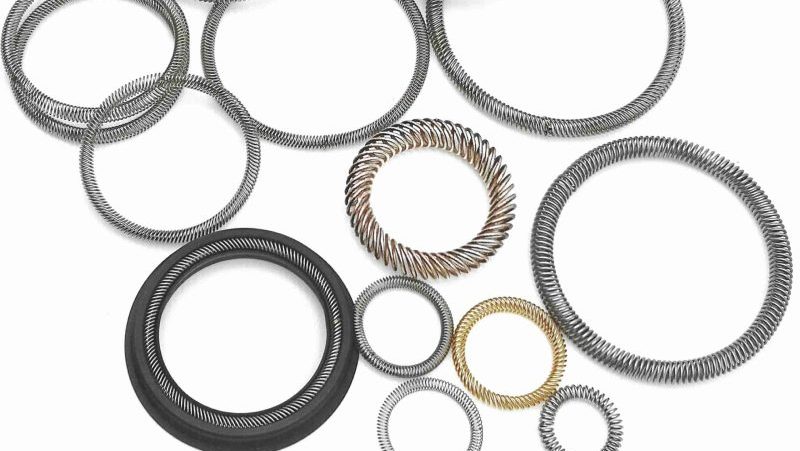
A canted coil spring is a specialized type of spring in which individual coils are angled (canted) rather than perpendicular to the spring axis. When customized for specific load, space, and environmental requirements, these springs provide exceptional force consistency, wide working deflection, and outstanding fatigue performance.
Custom canted coil springs are widely used in sealing systems, electrical contacts, EMI shielding, and precision mechanical assemblies across industries such as aerospace, semiconductor, medical, and industrial automation.
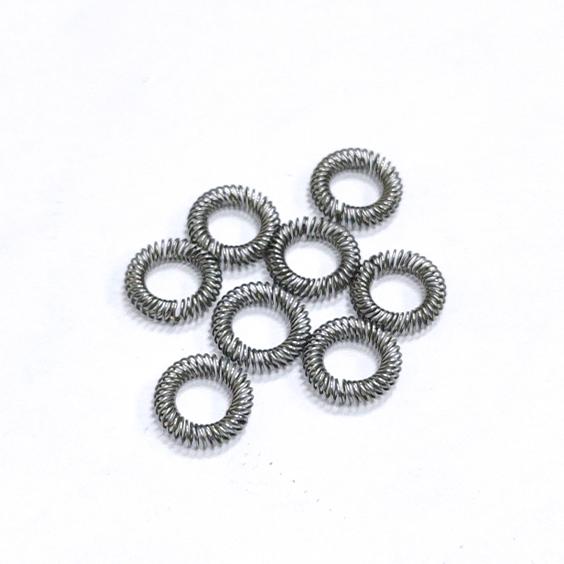
What Is a Custom Canted Coil Spring?
A custom canted coil spring is a spring engineered to meet application-specific requirements rather than relying on standard catalog dimensions. Customization can include:
-
Wire diameter and coil geometry
-
Spring height, inner/outer diameter
-
Load-deflection characteristics
-
Material and surface finish
-
Electrical conductivity or corrosion resistance
Unlike traditional compression springs, canted coil springs operate by rolling and flexing of angled coils, allowing them to maintain stable force output across a large deflection range.
How Canted Coil Spring Design Works
Angled Coil Geometry
The defining feature of a canted coil spring is the angled orientation of each coil. This geometry allows the coils to deflect smoothly under load rather than stacking or buckling.
As a result, the spring can:
-
Maintain nearly constant force
-
Absorb misalignment
-
Operate reliably in tight grooves
Custom Load Engineering
Through customization, engineers can precisely control:
-
Initial preload
-
Working force range
-
Maximum allowable deflection
This makes custom canted coil springs ideal for applications where consistent contact force is critical.
Custom Canted Coil Springs vs Traditional Springs
| Feature | Custom Canted Coil Springs | Traditional Compression Springs |
|---|---|---|
| Coil orientation | Angled (canted) | Straight |
| Force consistency | Excellent | Moderate |
| Deflection range | Wide | Limited |
| Misalignment tolerance | High | Low |
| Fatigue life | Very long | Moderate |
| Customization level | Extensive | Limited |
This comparison highlights why canted coil springs are often selected for high-performance and precision systems.
Key Advantages of Custom Canted Coil Springs
1. Consistent Force Over Wide Deflection
One of the biggest advantages of custom canted coil springs is their ability to deliver near-constant force across a large working range. This is critical in sealing and electrical contact applications.
2. Superior Fatigue Resistance
Because load is distributed evenly across multiple angled coils, stress concentration is minimized, resulting in exceptional fatigue life, even under millions of cycles.
3. Compact and Space-Efficient Design
Custom canted coil springs can be designed to fit narrow grooves and limited axial spaces, making them ideal for compact assemblies.
4. Excellent Environmental Adaptability
With the right material and surface treatment, these springs perform reliably in extreme temperatures, corrosive environments, and high-vibration conditions.
Common Materials Used in Custom Canted Coil Springs
| Material | Key Properties | Typical Applications |
|---|---|---|
| Stainless Steel (302/316) | Corrosion resistant, stable | General industrial, medical |
| Beryllium Copper | Excellent conductivity, fatigue resistance | Electrical contacts, EMI |
| Elgiloy® / MP35N | High strength, temperature resistant | Aerospace, defense |
| Inconel® / Hastelloy® | Extreme temperature & corrosion resistance | Oil & gas, chemical |
Material selection is a core part of customization and directly affects performance and longevity.
Typical Applications of Custom Canted Coil Springs
Spring-Energized Seals
Custom canted coil springs are commonly used as energizers in PTFE and polymer seals, ensuring consistent sealing force despite pressure changes or wear.
Electrical Contacts and Connectors
Thanks to their stable force and optional conductivity, canted coil springs are ideal for high-reliability electrical contacts.
EMI / RFI Shielding
When used in shielding gaskets, custom canted coil springs provide uniform contact pressure, improving shielding effectiveness.
Aerospace and Semiconductor Equipment
These industries rely on custom canted coil springs for precision motion control, vibration resistance, and long-term reliability.
Design Parameters for Custom Canted Coil Springs
| Parameter | Design Impact |
|---|---|
| Wire diameter | Determines load capacity |
| Coil count | Affects deflection range |
| Cant angle | Controls force curve |
| Free height | Sets installation preload |
| Surface finish | Influences wear and friction |
Proper optimization of these parameters ensures optimal performance for the target application.
Installation and Groove Design Considerations
Groove Geometry
Accurate groove width and depth are essential to allow proper spring movement without over-compression or side loading.
Preload Control
Custom canted coil springs are often designed with a specific preload to ensure immediate functionality upon installation.
Avoid Over-Compression
Exceeding the designed deflection range can reduce spring life and compromise system performance.
Customization Process: From Concept to Production
-
Application requirement analysis
-
Load and deflection modeling
-
Material and geometry selection
-
Prototype testing
-
Final production and quality control
This process ensures that each custom canted coil spring meets both performance and durability expectations.
Frequently Asked Questions (FAQ)
Are custom canted coil springs expensive?
While unit cost may be higher than standard springs, their long service life and reliability often reduce overall system cost.
Can custom canted coil springs replace O-rings or wave springs?
In many applications, yes—especially where consistent force, wear compensation, or high cycle life is required.
Are small-batch custom designs possible?
Yes. Many manufacturers support both prototyping and volume production.
Performance Comparison Chart
| Load Condition | Custom Canted Coil Spring | Conventional Spring |
|---|---|---|
| Initial compression | Smooth, stable | Uneven |
| Mid-range deflection | Constant force | Rising force |
| Long-term cycling | Minimal force loss | Fatigue degradation |
Conclusion
Custom canted coil springs provide unmatched design flexibility, reliability, and performance consistency for demanding mechanical, sealing, and electrical applications. Their ability to maintain stable force over wide deflection ranges, combined with excellent fatigue life and material versatility, makes them a preferred solution in high-end industries.
By working with a knowledgeable manufacturer and properly defining application requirements, custom canted coil springs can significantly enhance system performance, reduce maintenance, and extend product lifespan.