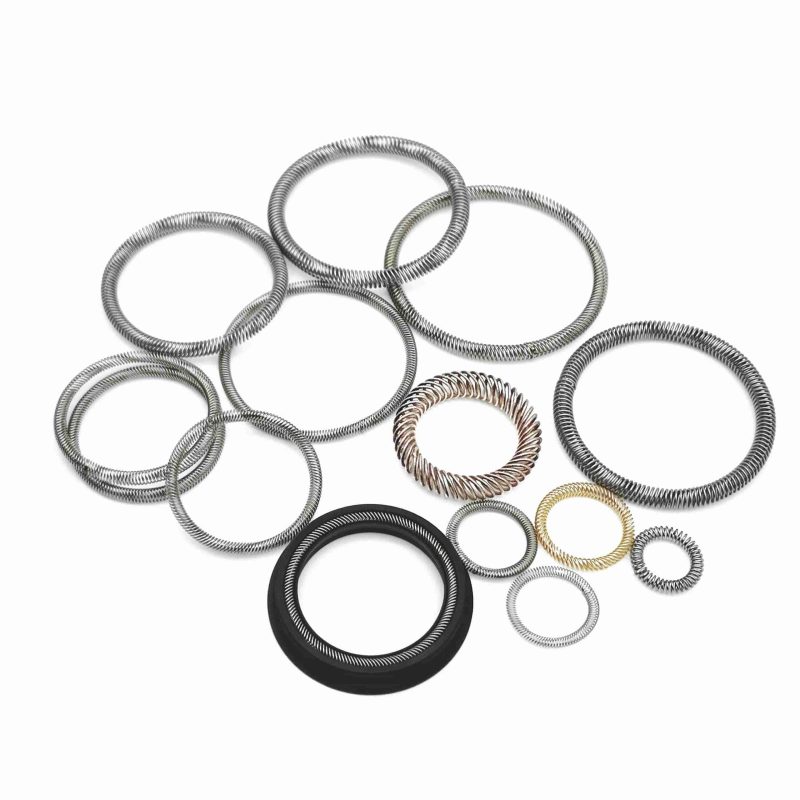
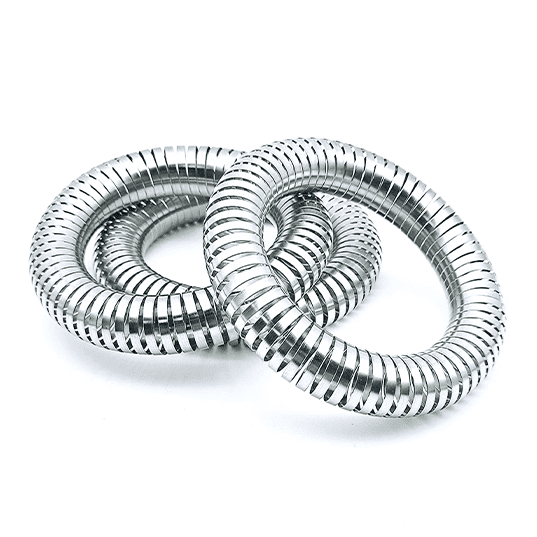
A canted coil spring energizer, sometimes referred to as a slant coil spring or canted coil seal spring, is a continuously wound spring designed to provide controlled elastic loading inside spring-energized sealing systems.
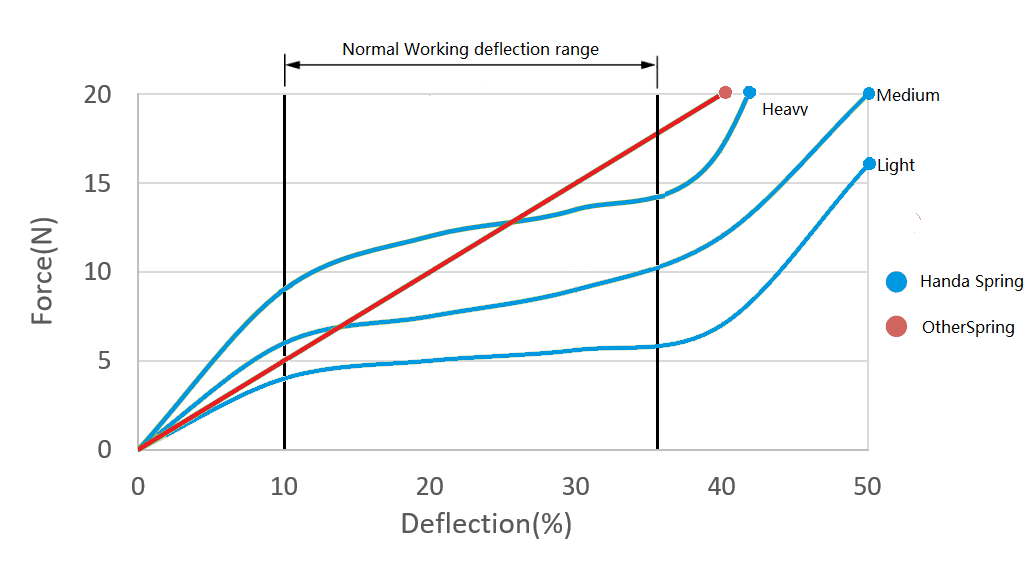
The inclined coil geometry allows each individual coil to deflect independently during compression, helping create smoother force distribution throughout the sealing interface. This unique structure enables relatively stable load output over larger working deflection ranges while reducing localized stress concentration and sealing friction.
Canted coil energizers are widely used in PTFE seals, PEEK seals, UHMWPE sealing systems, and other engineered polymer seal jackets requiring low friction, long cycle life, and stable preload force under demanding operating conditions.
Typical applications include dynamic sealing systems, cryogenic equipment, semiconductor processing equipment, aerospace actuators, vacuum systems, gas sealing, and precision motion assemblies.
Handa Spring provides custom canted coil spring energizers for different sealing structures, operating conditions, and performance requirements.
Customization options include:
Spring structures can be optimized according to gland dimensions, operating pressure, media compatibility, temperature range, and motion type. Closed-ring configurations can be precision formed, cut, and laser welded to improve roundness consistency and load stability.

Different spring energizer structures are designed for different sealing requirements. Slant coil springs are generally preferred for low-friction dynamic applications, while helical springs are commonly used for higher sealing loads and cantilever springs are often selected for lighter preload conditions.
| Comparison Item | Canted Coil Spring Energizer | Helical Spring Energizer | V-Spring Energizer | U-Spring Energizer | Full Contact Spring Energizer | Detached Leg Spring Energizer |
|---|---|---|---|---|---|---|
| Spring Structure | Continuous inclined independent coil structure | Continuous helical compression coil structure | V-shaped cantilever spring structure | U-shaped cantilever spring structure | Continuous full-contact spring profile | Separated leg spring structure with independent support points |
| Main Deflection Principle | Independent coil compression deformation | Helical axial compression | Cantilever elastic deflection | Cantilever elastic deflection | Continuous surface elastic contact | Elastic deformation through detached support legs |
| Load Characteristics | Near-constant force over larger deflection ranges | Higher spring load with more noticeable force increase | Moderate and responsive spring load | Softer spring response | Uniform contact load distribution | Higher localized contact force |
| Friction Characteristics | Typically low friction behavior | Generally higher friction due to higher contact load | Low friction performance | Low friction performance | Moderate friction depending on contact area | Relatively higher local friction points |
| Dynamic Response | Excellent dynamic compensation capability | More suitable for static or lower-speed motion | Excellent for reciprocating motion | Good dynamic sealing capability | Stable in moderate dynamic conditions | Suitable for pressure-intensive static sealing |
| Sealing Compensation Capability | Excellent compensation for wear, eccentricity, and tolerance variation | More focused on stable high-load sealing | Excellent compensation performance | Good compensation capability | Excellent surface conformity | Strong compensation under high compression loads |
| Suitable Motion Type | Dynamic and reciprocating systems | Static or low-speed systems | High-frequency reciprocating motion | General dynamic motion | Static and moderate dynamic systems | Primarily static applications |
| Contact Pressure Characteristics | Smoother and more stable contact pressure | Higher concentrated sealing force | Balanced contact pressure distribution | Lower contact pressure | Continuous full-surface contact pressure | Higher localized sealing pressure |
| Breakout / Startup Friction | Typically low breakout force | Usually higher startup friction | Low breakout friction | Low breakout friction | Moderate breakout force | Higher startup resistance |
| Cycle Life Performance | Excellent long-cycle fatigue performance | Stable long-term static loading capability | Excellent fatigue resistance | Good fatigue resistance | Good long-term sealing stability | Designed for heavy-duty sealing conditions |
| Pressure Capability | Suitable for medium-to-high pressure systems | Excellent for high and ultra-high pressure sealing | Medium pressure capability | Medium pressure capability | High-pressure static sealing capability | Excellent high-pressure resistance |
| Primary Advantages | Low friction, dynamic compensation, stable load response | High sealing load and static sealing stability | Excellent dynamic sealing response | Low friction dynamic sealing | Uniform sealing contact performance | Strong sealing stability under extreme compression |
| Typical Applications | Semiconductor, vacuum, gas sealing, dynamic equipment | LNG, valves, oil & gas, high-pressure systems | Hydraulic systems, reciprocating seals | Medical devices, precision equipment | Static sealing, flange systems, pressure vessels | Ultra-high-pressure sealing systems |
| Common Industries | Aerospace, semiconductor, robotics, vacuum systems | Oil & gas, LNG, industrial valves | Hydraulics, chemical processing | Medical, semiconductor, precision motion | Energy, industrial equipment, pressure systems | Heavy industry, energy, high-pressure equipment |
| Manufacturing Complexity | High | Moderate to high | Moderate | Moderate | High | High |
| Relative Manufacturing Cost | Relatively high | Moderate | Moderate | Moderate to low | High | High |
Selecting the correct spring geometry depends on operating pressure, friction requirements, temperature range, motion type, media compatibility, and expected service life.
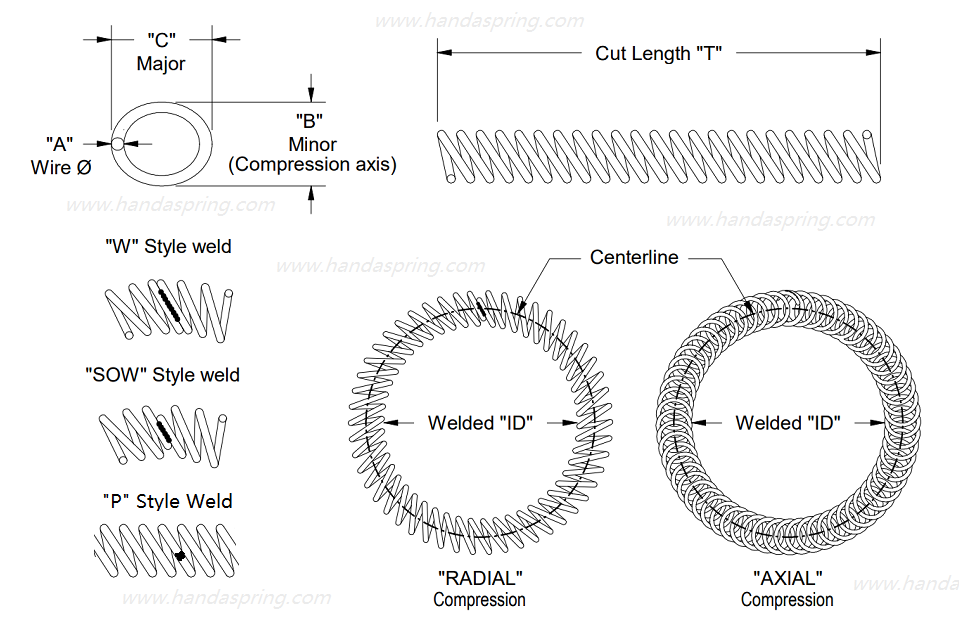
The most visible difference between a canted coil spring and other spring types is its cross-section, which is elliptical or oval, not circular. Key design characteristics of the spring are its wire diameter (A), coil height (B), coil width (C), coil spacing, Welded Inner Dimensional(ID). Each of these can be precisely adjusted to influence force, electrical contact resistance, and other properties. The orientation of a spring’s coils in relation to the centerline determines whether it is axial or radial. Compression force for a radial canted coil spring is along the radius of the arc or ring, perpendicular to the centerline. Compression force for an axial canted coil spring is along the axis of the arc or ring, parallel to the centerline.
We can produce custom-made slant coil springs in nearly any size based on your samples or drawings.
Min Size Range:
B/C sizes ≈Ø0.4mm(0.0157″)
ID=1mm(0.039″)
***If you can’t find the geometry you’d like in the table below, a unique toolset can be designed specifically for your application. Ask an Handa expert for details.
| Series | Typical Load | “A” (Wire OD) |
“B” (Width) |
“C” (Height) |
“T” (Cut Length) |
“ID” |
|---|---|---|---|---|---|---|
| HD-CS-L132 | L | 0.08 | 0.62 | 0.70 | 7.60 | 1.80 |
| HD-CS-M132 | M | 0.10 | 0.62 | 0.70 | 7.60 | 1.80 |
| HD-CS-H132 | H | 0.12 | 0.65 | 0.75 | 7.70 | 1.80 |
| HD-CS-L000 | L | 0.12 | 1.40 | 1.55 | 12.90 | 2.70 |
| HD-CS-M000 | M | 0.15 | 1.40 | 1.55 | 12.90 | 2.70 |
| HD-CS-H000 | H | 0.20 | 1.20 | 1.32 | 12.20 | 2.70 |
| HD-CS-L100 | L | 0.18 | 2.00 | 2.40 | 19.80 | 4.30 |
| HD-CS-M100 | M | 0.35 | 2.00 | 2.40 | 20.10 | 4.40 |
| HD-CS-H100 | H | 0.35 | 2.00 | 2.30 | 19.80 | 4.30 |
| HD-CS-L200 | L | 0.30 | 2.80 | 3.20 | 30.10 | 6.80 |
| HD-CS-M200 | M | 0.35 | 2.80 | 3.20 | 30.10 | 6.80 |
| HD-CS-H200 | H | 0.40 | 2.80 | 3.20 | 30.10 | 6.80 |
| HD-CS-L300 | L | 0.40 | 4.00 | 4.50 | 42.70 | 9.60 |
| HD-CS-M300 | M | 0.50 | 4.00 | 4.50 | 42.70 | 9.60 |
| HD-CS-H300 | H | 0.60 | 4.00 | 4.50 | 42.70 | 9.60 |
| HD-CS-L400 | L | 0.50 | 5.50 | 6.00 | 61.20 | 14.00 |
| HD-CS-M400 | M | 0.60 | 5.50 | 6.00 | 61.20 | 14.00 |
| HD-CS-H400 | H | 0.70 | 5.50 | 6.00 | 61.20 | 14.00 |
| HD-CS-L500 | L | 0.60 | 8.20 | 9.20 | 96.40 | 22.50 |
| HD-CS-M500 | M | 0.70 | 8.20 | 9.20 | 96.40 | 22.50 |
| HD-CS-H500 | H | 1.00 | 8.20 | 9.20 | 96.40 | 22.50 |
| HD-CS-L600 | L | 0.70 | 11.40 | 12.80 | 152.00 | 37.00 |
| HD-CS-M600 | M | 1.00 | 11.40 | 12.80 | 152.00 | 37.00 |
| HD-CS-H600 | H | 1.20 | 11.40 | 12.80 | 152.00 | 37.00 |
Q: What is a canted coil spring used for?
A: Canted coil spring energizers are primarily used inside spring energized seals to provide stable preload force under dynamic and static sealing conditions. They are also used for EMI shielding, grounding, conductivity, and mechanical retaining applications.
Q: What materials can Handa Spring use for these springs?
A: Common materials include Elgiloy®, Inconel®, Hastelloy®, MP35N®, stainless steel alloys, and beryllium copper depending on temperature, corrosion resistance, conductivity, and fatigue requirements.
Q: Are canted coil spring energizers suitable for dynamic sealing?
A: Yes. Due to their relatively stable load response and low friction characteristics, they are widely used in reciprocating, rotary, and other dynamic sealing systems.
Q: Can I request a custom size or load specification?
A: Yes. Handa Spring supports full customization and prototyping—including free consultation and sample evaluation.