- Do you need help? Here Us:
- +86 13169905499
- sunny@handaspring.com
- Wechat:13169905499

 English
  中文 (中国)
Chenzhou, Hunan, China(423000)

- 2026年3月17日
- handasprings
- Read: 772
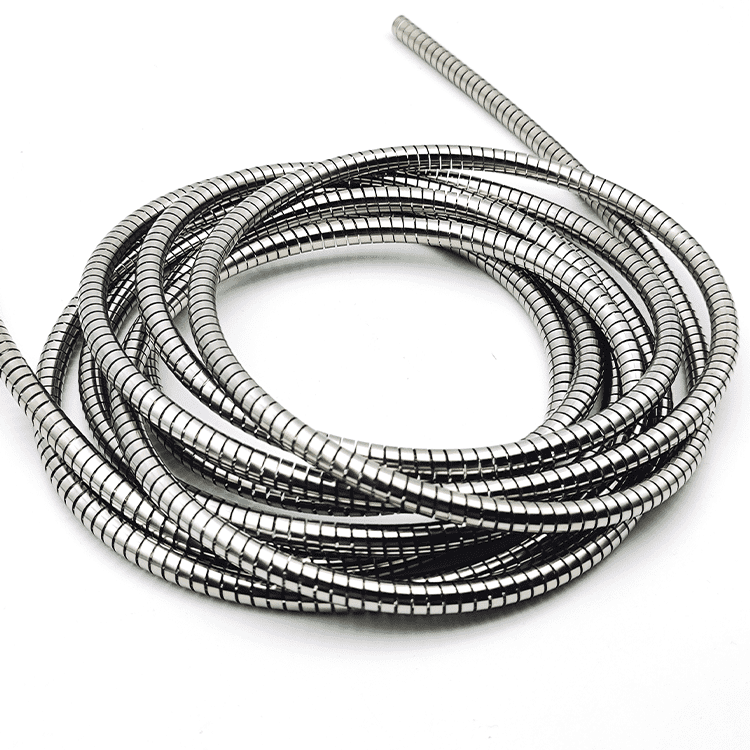
A helical spring is a reliable elastic component typically manufactured by winding wire into a helix shape to store mechanical energy and release it when required . These essential mechanical elements are found in countless applications—from the suspension systems in automobiles that absorb road shocks to the delicate mechanisms in medical devices and aerospace components .Helical Springs are our strength.
Springs are elastic machine elements that deflect when loaded, storing energy and releasing it upon returning to their original position . They serve five primary functions in mechanical systems:
-
Controlling motion (e.g., engine valves, clutches)
-
Absorbing vibration and shock (e.g., vehicle suspensions)
-
Measuring force (e.g., spring balances, load transducers)
-
Storing energy (e.g., clocks, toys)
This comprehensive guide explores helical spring types, materials, design principles, and applications to help engineers and designers make informed decisions.
Types of Helical Springs
Helical springs are classified primarily by the direction of the loads they accommodate . The three main subtypes are compression, tension, and torsion springs.
1. Helical Compression Springs
Compression springs are designed to resist compressive forces—the coils compress together under an applied load, storing compressive energy . They are characterized by open coils that provide resistance when pushed together .
Key characteristics:
-
Open coils that allow axial compression
-
Various end configurations (plain, plain-ground, squared, squared-ground)
Specialized compression spring variants:
Conical springs offer the advantage that the compressed height is small, making them ideal for applications with limited space, such as upholstery .
2. Helical Extension Springs
Extension springs are designed to resist tension forces. Unlike compression springs, their coils are wound tightly together because the coils are pulled apart under an applied load . As the coils separate, they store energy and create a resisting force opposite to the spring extension direction .
Key characteristics:
-
Tightly wound coils with initial tension
-
Various end hooks or loops for attachment
-
Similar stress and deflection formulas to compression springs
The length inside hooks (LIH) is a critical measurement for extension springs, determined by measuring from the exterior of hooks on each end and subtracting twice the wire diameter .
3. Helical Torsion Springs
Torsion springs are engineered to resist twisting forces. These tightly wound wire coils unwind elastically under applied torsion, storing energy by resisting forces that try to twist the spring coil into a tighter wind .
Key characteristics:
-
Legs or arms that transmit torque
-
Angular deflection rather than linear movement
-
End configurations defined by leg angles
The leg configuration is determined by counting the number of coils—for example, five coils produce a zero-degree spring, 5.25 coils produce a 90-degree spring, and 5.75 coils produce a 170-degree spring .
Design formula for torsion springs:
Angle of twist θ = 64TDn/Ed⁴
Maximum bending stress σm = 32T/πd³
Where:
-
T = applied torque
-
D = mean diameter
-
n = number of active coils
-
d = wire diameter
-
E = Young’s modulus
Helical Spring Materials
Material selection is critical for helical spring performance, affecting load capacity, corrosion resistance, temperature tolerance, and service life .
Common Spring Materials
Material Selection Criteria
When selecting helical spring materials, consider these factors :
-
Load requirements: High-stress applications may require music wire or chrome silicon
-
Environmental conditions: Corrosive environments demand stainless steel or specialty alloys
-
Temperature range: Elevated temperatures require Inconel or precipitation-hardening stainless steels
-
Electrical conductivity: Beryllium copper or phosphor bronze for current-carrying springs
-
Cost constraints: ASTM A229 wire offers economy for non-critical applications
The material influences the volume of space required for a particular application. Research shows that volume is proportional to material constants: V α G⁷S¹⁵, where G is torsional modulus and S is the limit of maximum stress .
Using music wire as a baseline (1.00), the relative volume requirements for different materials in small motor brush springs operating up to 100°C are :
-
Stainless steel: 1.06
-
Beryllium copper: 1.34
-
Phosphor bronze: 2.66
Helical Spring Design and Calculations
Key Design Parameters
Critical geometric properties define a helical coil spring :
| Parameter | Definition | Measurement Method |
|---|---|---|
| Wire Diameter (d) | Diameter of wire forming the spring | Measure at both ends with calipers |
| Outer Diameter (OD) | Outside diameter of spring coils | Measure across outer surfaces |
| Mean Diameter (D) | D = OD – d | Calculated from OD and wire diameter |
| Free Length (L) | Length of uncompressed spring | Measure entire spring length |
| Spring Index (C) | C = D/d | Ratio of mean diameter to wire diameter |
| Number of Coils (n) | Total active coils | Count including coil fractions |
| Pitch (p) | Distance between coil centers | L/(n + 1) for compression springs |
For stability, the free length to mean diameter ratio (L/D) should be approximately 2 to 3 .
Stress and Deflection Formulas
For Close-Coiled Helical Springs
Spring constant (stiffness):
s = Gd/8nC³
Deflection:
y = W/s
Maximum shear stress:
τ = 8WCK/πd²
Where:
-
G = shear modulus
-
W = applied load
-
K = Wahl factor (stress concentration factor)
The Wahl factor accounts for curvature and direct shear effects:
K = (4C – 1)/(4C – 4) + 0.615/C
Wire Diameter Calculation
For a given load and allowable stress:
d = √(8WCK/πτ)
Compression Spring Design Example
A typical design problem involves proportioning helical springs by minimum weight. For a detent spring where force P₁ = 20 lb, after 0.625 in compression, shear stress = 75,000 lb/in², with spring index C ≈ 8 :
Wire diameter calculation:
d = √[(16 × 20 × 8)/(π × 75,000)] = 0.1042 in
The nearest commercially available size would be selected from wire tables .
Industry Applications
Helical springs serve critical functions across virtually every industry .
Aerospace Applications
Automotive Applications
Helical springs are essential in automobile suspension systems to absorb shocks from road irregularities and provide comfortable rides . They’re also found in:
Medical Applications
Industrial and Consumer Products
-
Industrial machinery: Die springs for shock absorption, press machines, injection molding equipment
-
Consumer products: Mattresses, door locks, air conditioners, retractable pens
-
Rail transportation: Bogies for freight and passenger trains
-
Electronics: Switches, connectors, battery contacts
Advanced Developments: Composite Helical Springs
Recent advances in materials science have led to the development of composite helical springs fabricated from fiber-reinforced plastics .
Advantages of Composite Springs
-
Weight reduction: At least 50% weight savings compared to steel springs while maintaining function
-
Superior fatigue strength: Enhanced durability and “fail-safe” capabilities
-
Excellent corrosion resistance: No rust or degradation in harsh environments
-
Higher natural frequency: Better vibration isolation properties
Current Applications
Composite helical springs have been applied in Audi A6 and Audi R8 models . Research continues into injection-winding manufacturing methods to simplify production and improve performance .
However, widespread adoption faces challenges including cost limitations, mass production process development, and the need for more systematic research into design methods and performance investigation .
Selection Guide: Choosing the Right Helical Spring
Step-by-Step Selection Process
-
Determine load direction
-
Compressive load → Compression spring
-
Tensile load → Extension spring
-
Rotational load → Torsion spring
-
-
Calculate required spring rate
-
Evaluate space constraints
-
Available diameter → Determines spring index
-
Available length → Determines free length and number of coils
-
-
Select material based on environment
-
Standard environments → Music wire or oil-tempered
-
Corrosive → Stainless steel
-
High temperature → Inconel or 17-7 PH
-
Electrical conductivity → Beryllium copper
-
-
Consider special requirements
-
Progressive rate needed → Conical or barrel springs
-
Zero friction requirement → Consider air or gas springs
-
Extreme loads → Die springs or heavy-duty variants
-
Measurement Tips
For accurate spring selection and verification :
-
Use calipers for all dimensional measurements
-
Measure wire diameter at both ends to ensure consistency
-
For extension springs, measure length inside hooks carefully
-
Count coil fractions accurately (0.25, 0.5, 0.75 coils)
Frequently Asked Questions
What is the spring rate of a helical coil spring?
For extension and compression springs, spring rate is the load required to achieve a unit of deformation, measured in pounds per inch (lb/in) or Newtons per millimeter (N/mm). It is determined by wire diameter, number of coils, and coil diameter .
How do I measure a helical spring?
Use calipers to measure outside diameter across the coil surfaces, wire diameter at both ends, and free length from end to end. Count total coils including fractions .
What material should I choose for high-temperature applications?
Consider stainless steel (302, 316) for moderate temperatures, or advanced nickel-based alloys like Inconel X750 for very high temperatures .
How do I prevent spring failure?
Consider operating stress levels, avoid exceeding design deflection, ensure proper material selection for the environment, and consider shot peening for improved fatigue life .
Conclusion
Helical springs are fundamental mechanical components that enable countless machines and devices to function reliably. Understanding the distinctions between compression, tension, and torsion springs—along with proper material selection and design calculations—ensures optimal performance for any application.
From traditional steel springs to advanced composite designs, the evolution of helical spring technology continues to enable innovation across aerospace, automotive, medical, and industrial sectors. By applying the design principles and selection criteria outlined in this guide, engineers can specify helical springs that deliver reliable, long-lasting service in even the most demanding environments.