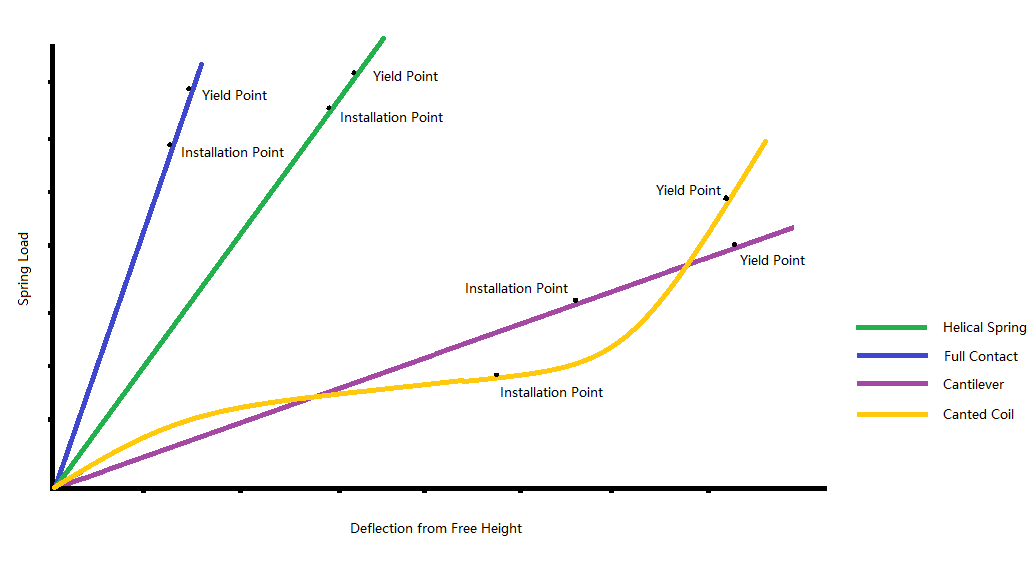
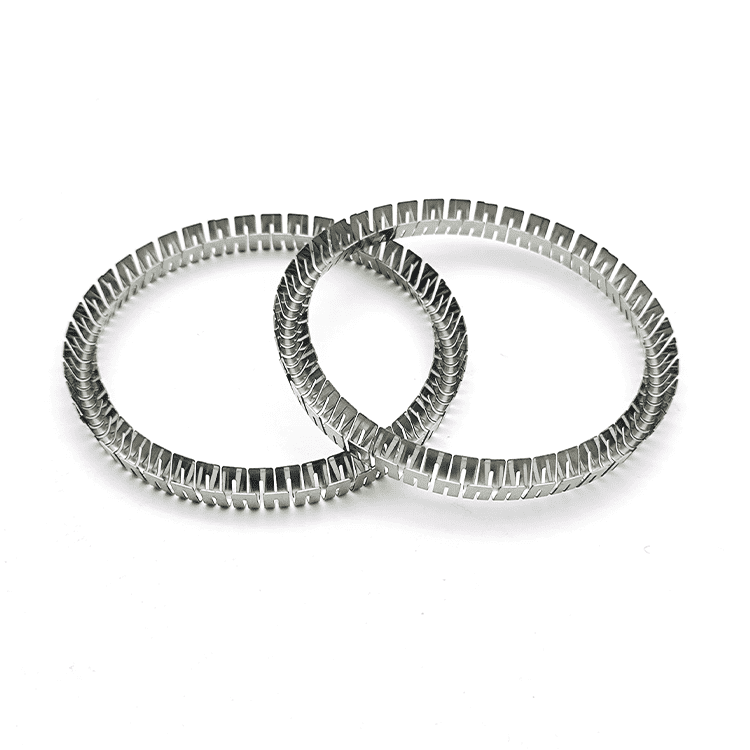
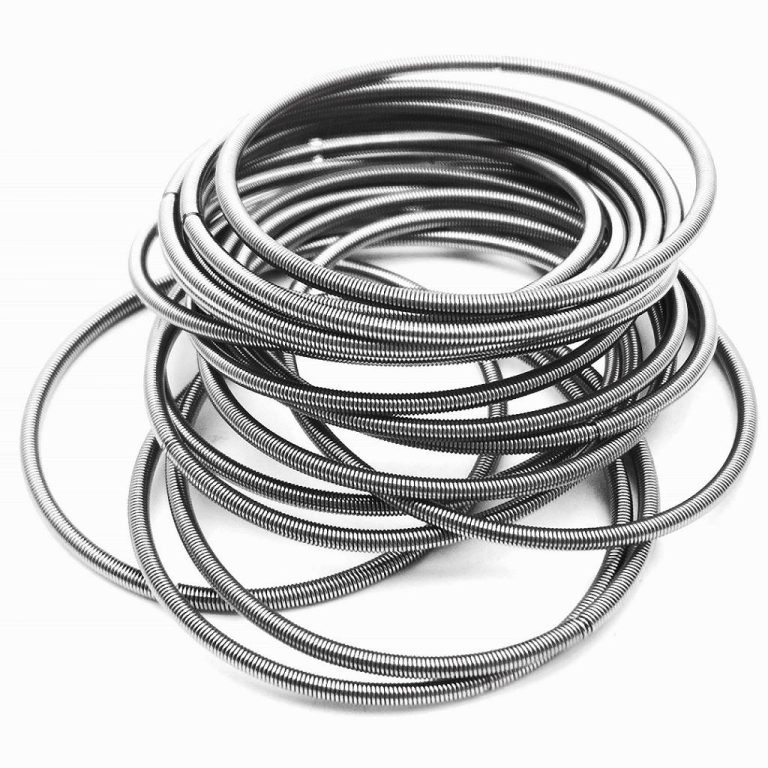
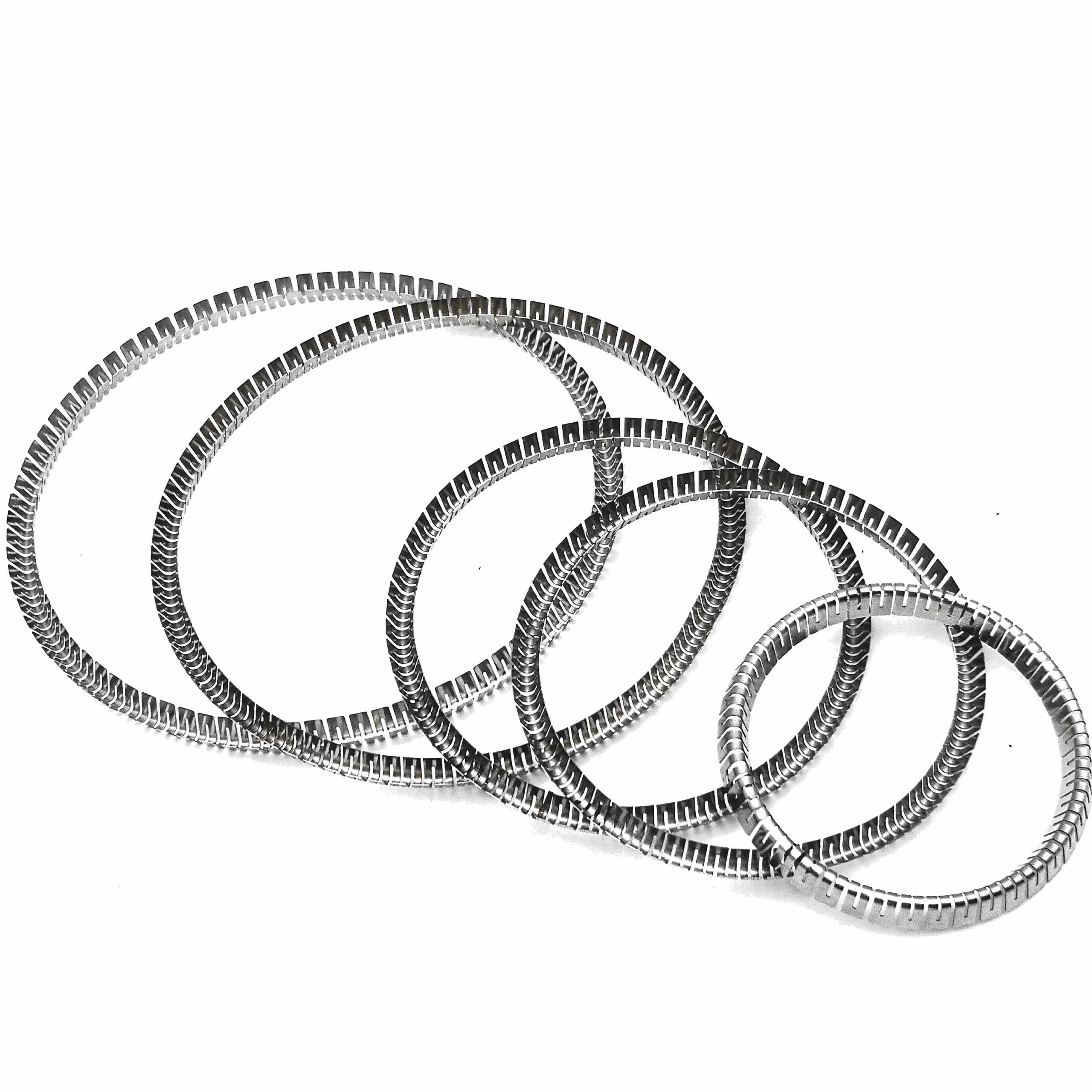
Spring energizer performance is closely related to the relationship between spring deflection and spring force. Different spring profiles are engineered to provide different load characteristics, allowing the sealing system to maintain the required contact force as operating conditions change.
The spring is compressed or deflected within the sealing assembly.
The spring generates mechanical preload against the sealing jacket.
Spring force creates and maintains contact between the seal and mating surface.
The resulting contact force supports sealing performance during pressure, temperature, wear, and motion changes.
Product Systems
Different sealing applications require different combinations of spring geometry, spring force, deflection characteristics,
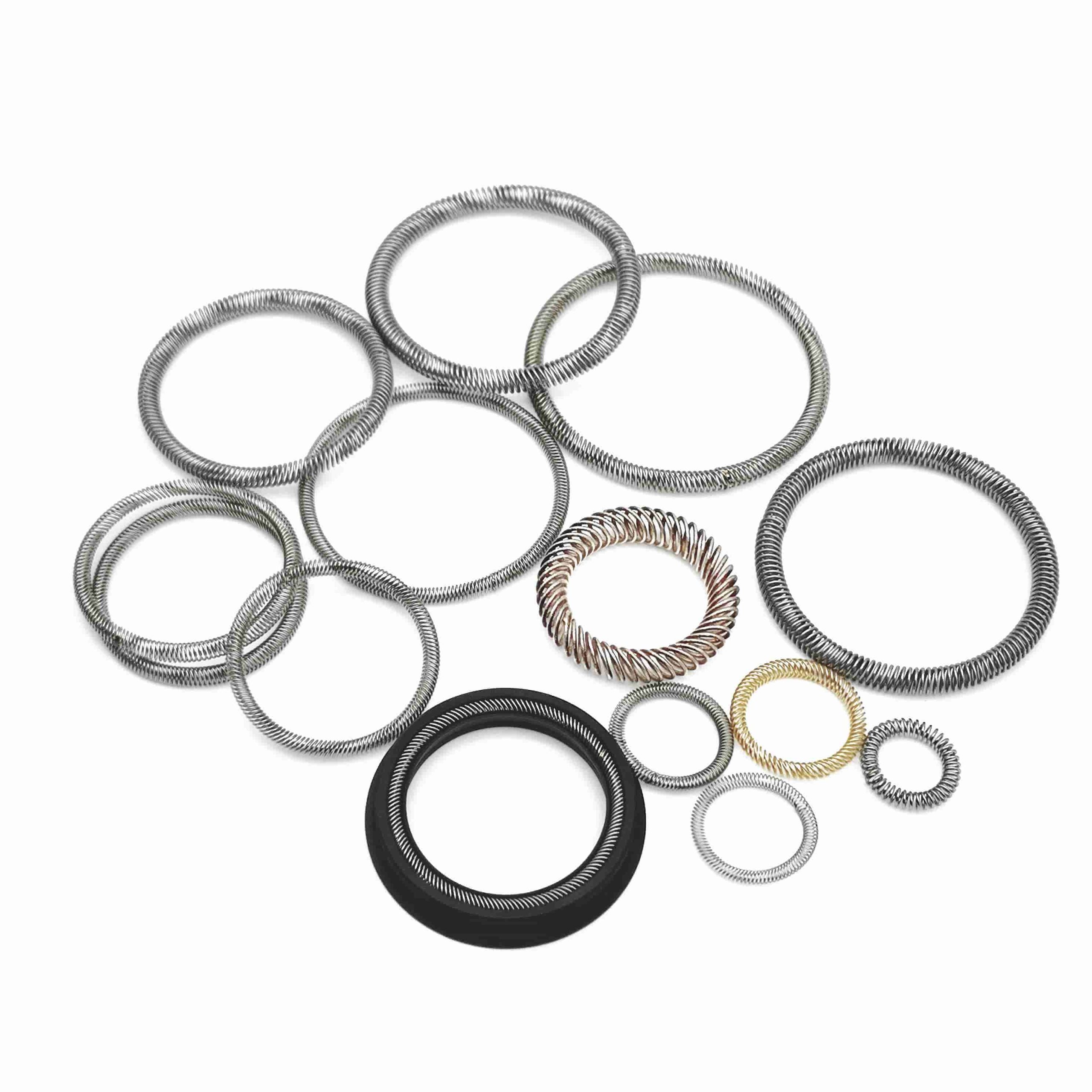
installation space, and operating conditions. Handa Spring manufactures a range of spring energizer configurations for static, dynamic, vacuum, cryogenic, high-cycle, and space-constrained sealing systems.

Provide nearly constant spring force across a wide deflection range, making them suitable where stable contact pressure is required despite dimensional tolerances, wear, or thermal movement.

Provide higher spring loading for static and slow dynamic sealing applications where reliable sealing performance under elevated pressure and limited installation space is required.

Designed for low-friction dynamic sealing applications, offering stable elastic loading and reduced running friction for reciprocating and rotary motion.

Suitable for medium and low-pressure dynamic sealing systems requiring balanced spring loading, smooth movement, and reliable elastic compensation.

Provide continuous circumferential support around the seal, making them particularly suitable for vacuum, cryogenic, gas sealing, and other applications where leakage control is critical.

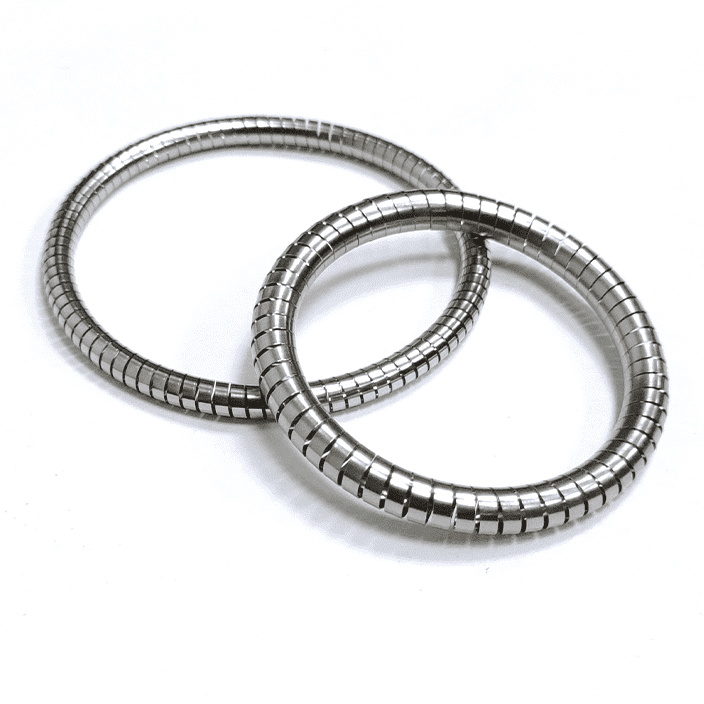
Offer flexibility for seals installed in restricted spaces or complex gland geometries while maintaining reliable elastic compensation during installation and operation.

Circular spring energizers manufactured to provide controlled radial loading in sealing systems where a continuous circumferential spring element is required.
Spring selection should begin with the operating requirements of the sealing system rather than with dimensions alone. The spring geometry, material, and force characteristics should be matched to the way the seal will operate.
What level of spring loading and contact force is required?
Is the spring installed in a conventional gland or restricted geometry?
Temperature, pressure, vacuum, chemicals, gas, or other environmental conditions?
Select an alloy based on temperature, media compatibility, fatigue requirements, and expected service conditions.
Match the load-deflection characteristics and required spring force to the sealing system.
If the required spring profile or force is not clear, Handa Spring can review your drawing, sample, or application requirements before production.
The spring material is an important part of the complete spring energizer specification. Depending on the operating environment and spring configuration, material selection can influence corrosion resistance, temperature capability, spring force stability, fatigue performance and service life.
Note: The appropriate material should be evaluated according to the actual operating conditions rather than selected from material properties alone. Contact our engineering team for application-specific material recommendations.
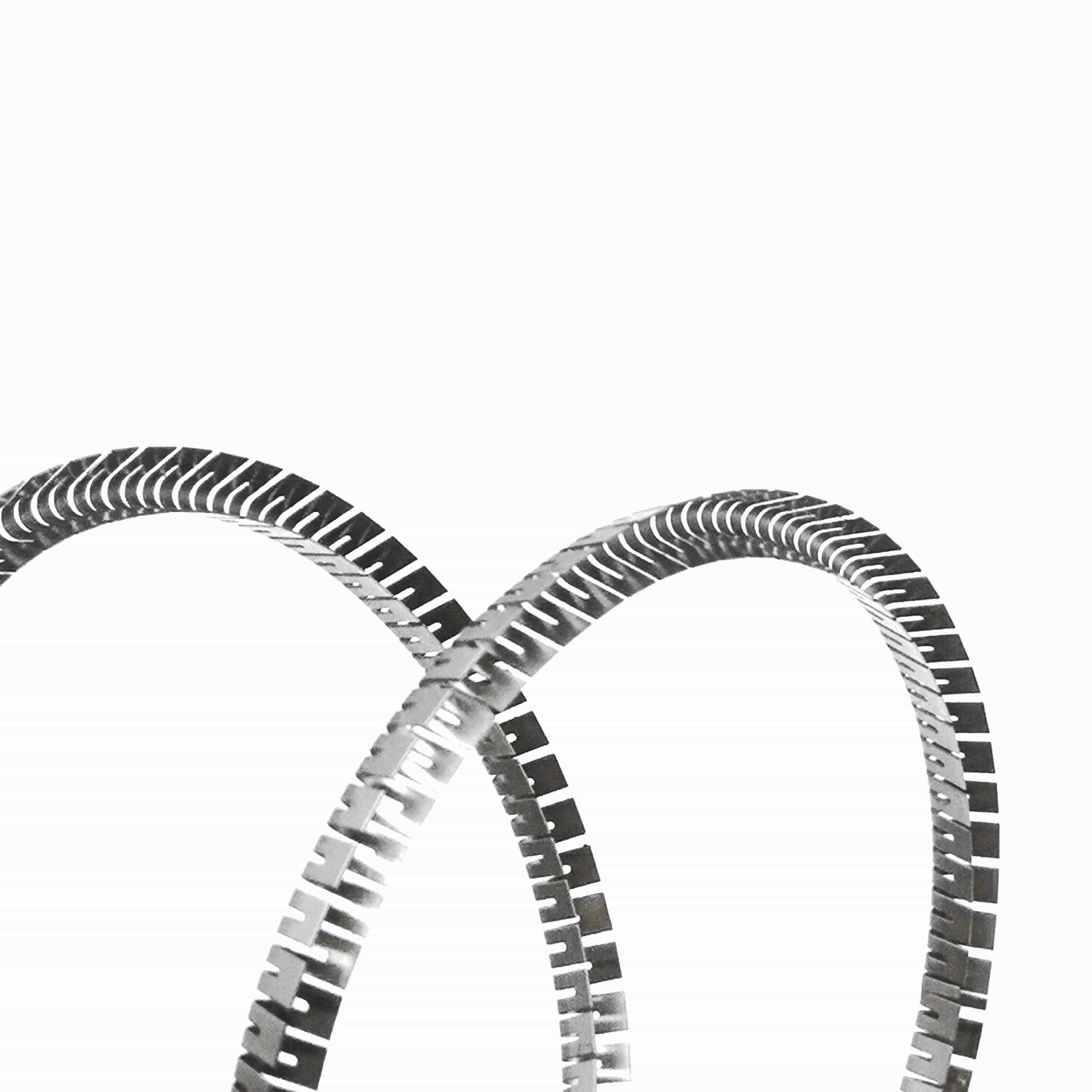
Spring energizer performance depends not only on material selection and spring geometry, but also on forming accuracy, spring force control, heat treatment, finishing, and dimensional consistency. Handa Spring supports different manufacturing routes for wire-formed and strip-formed spring energizers.
Spring geometry, material, and spring force must be matched to the environment in which the sealing system operates. Explore the conditions most commonly associated with spring-energized sealing applications.
Spring energizer applications requiring material and spring characteristics suitable for elevated temperatures.
Sealing systems where spring loading and spring geometry must support demanding pressure conditions.
Aggressive chemical environments requiring corrosion-resistant spring materials and appropriate spring configurations.
Reciprocating and rotary sealing systems requiring controlled friction and stable spring loading.
Dynamic sealing applications where spring force and friction characteristics must remain controlled during high-speed movement.
Repeated compression and dynamic applications requiring appropriate spring material and force characteristics.
Clean sealing environments where material selection, cleaning, and dimensional consistency are important.
Spring energizer configurations for restricted installation areas and complex gland geometries.
Spring-energized sealing systems where stable contact force and leakage control are critical.
Applications requiring controlled spring force, appropriate material selection, and consistent manufacturing quality.
The spring itself is only one part of the sealing system. Spring geometry, material, force, and manufacturing accuracy must be matched to the requirements of the application.
Why Handa
Handa Spring combines spring engineering knowledge, manufacturing capability, material experience, and project support to help customers move from prototype requirements to stable production.
We evaluate suitable alloys based on operating temperature, media, spring geometry, and expected service requirements rather than material availability alone.
Wire and strip manufacturing routes support different spring energizer configurations, including custom dimensions and application-specific requirements.
Existing tooling and custom tooling capability support prototype development for standard and non-standard spring geometries.
Production batches can be verified using calibrated force testing equipment to ensure spring force meets customer specifications.
Heat treatment and stress-relieving processes are available for applicable spring materials and production requirements.
We support prototype development, small-batch qualification, and volume production from the same manufacturing platform.
Handa Spring works with seal manufacturers, engineering firms, and equipment OEMs across North America, Europe, and Asia. Our objective is to become part of the customer’s engineering process—from prototype development and qualification through long-term production.
Contact Handa
Whether you already have production drawings or are still evaluating spring geometry, our engineering team can help review your application, recommend suitable materials, and support prototype development.